

What materials are commonly used in air tire inflators?
Jul 04, 2025
As a seasoned supplier of air tire inflators, I've witnessed firsthand the evolution of materials used in these essential tools. Air tire inflators are crucial for maintaining proper tire pressure, which is not only essential for vehicle safety but also for optimizing fuel efficiency and tire lifespan. In this blog post, I'll delve into the commonly used materials in air tire inflators, their characteristics, and how they contribute to the performance of these devices.
Metals
Metals are one of the most widely used materials in air tire inflators due to their strength, durability, and heat conductivity.
Aluminum
Aluminum is a popular choice for many components of air tire inflators, such as the compressor housing and cylinder. It is lightweight, corrosion-resistant, and has excellent heat dissipation properties. These characteristics make it ideal for applications where weight and heat management are critical. For example, in portable air tire inflators, the use of aluminum helps reduce the overall weight, making them easier to carry around. Additionally, its corrosion resistance ensures a longer lifespan, even in harsh environments.
Steel
Steel is another commonly used metal in air tire inflators, particularly for parts that require high strength and durability. The piston rods, for instance, are often made of steel. Steel's high tensile strength allows it to withstand the high pressures generated during the inflation process without deforming. It also has good wear resistance, which is essential for components that experience repeated friction, such as the piston rods moving inside the cylinder. However, steel is heavier than aluminum, so it is typically used in parts where strength is the primary concern rather than weight reduction.
Copper
Copper is used in some air tire inflators, mainly for its excellent electrical conductivity. In electric air tire inflators, copper wires are used to conduct electricity from the power source to the motor. Its low electrical resistance ensures efficient power transfer, reducing energy loss and heat generation. Copper also has good corrosion resistance, which helps maintain the integrity of the electrical connections over time.
Plastics
Plastics have become increasingly popular in the manufacturing of air tire inflators due to their versatility, cost-effectiveness, and ease of molding.
Polypropylene (PP)
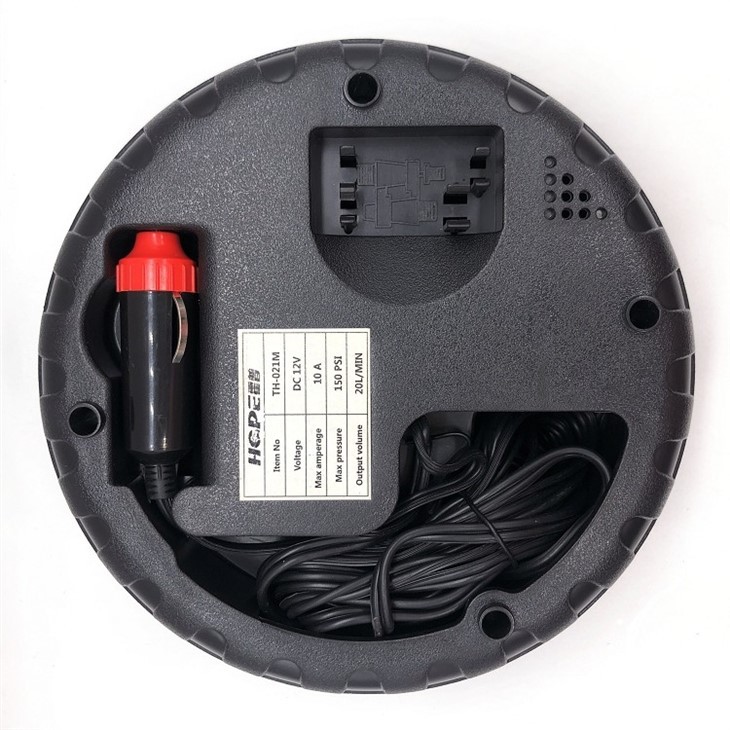
Polypropylene is a widely used plastic in air tire inflators. It is lightweight, chemical-resistant, and has good impact strength. Many of the outer casings of air tire inflators are made of polypropylene. Its lightweight nature contributes to the overall portability of the device, while its chemical resistance protects the internal components from damage caused by exposure to various chemicals. Additionally, its good impact strength ensures that the inflator can withstand minor drops and bumps without cracking.

Acrylonitrile Butadiene Styrene (ABS)
ABS is another common plastic used in air tire inflators. It is a strong and rigid plastic with good dimensional stability. ABS is often used for parts that require a high level of precision, such as the control panels and the housings for the electronic components. Its high strength and rigidity prevent the parts from warping or deforming under normal operating conditions, ensuring the proper functioning of the inflator.
Polycarbonate (PC)
Polycarbonate is a clear, tough plastic with excellent impact resistance and transparency. In some air tire inflators, polycarbonate is used for the viewports or windows, allowing users to see the internal components or the inflation process. Its high impact resistance ensures that the viewports can withstand accidental impacts without breaking, while its transparency provides a clear view of the inside of the inflator.
Rubber
Rubber is an essential material in air tire inflators, primarily for its sealing and vibration-damping properties.
Natural Rubber
Natural rubber is used in some air tire inflators for its excellent elasticity and sealing properties. It is commonly used in the gaskets and seals that prevent air leakage from the compressor and the hoses. Its high elasticity allows it to form a tight seal even under high pressures, ensuring efficient inflation. Natural rubber also has good resistance to abrasion, which is important for components that are in contact with other surfaces.
Synthetic Rubber
Synthetic rubbers, such as neoprene and nitrile rubber, are also used in air tire inflators. Neoprene is resistant to oil, ozone, and weathering, making it suitable for use in hoses that may come into contact with oil or be exposed to the elements. Nitrile rubber, on the other hand, has excellent resistance to fuel and chemicals, which is beneficial for inflators used in automotive applications.
Composite Materials
Composite materials are combinations of two or more different materials, designed to take advantage of the properties of each component.
Fiberglass Reinforced Plastics (FRP)
Fiberglass reinforced plastics are used in some high-performance air tire inflators. Fiberglass provides high strength and stiffness, while the plastic matrix provides corrosion resistance and ease of molding. FRP is often used in parts that require both strength and light weight, such as the frames or supports of the inflator. It can offer a good balance between the strength of metals and the lightweight properties of plastics.
Conclusion
The materials used in air tire inflators play a crucial role in determining their performance, durability, and cost. Metals provide strength and heat conductivity, plastics offer versatility and cost-effectiveness, rubber ensures proper sealing and vibration damping, and composite materials can offer a combination of desirable properties. As a supplier of air tire inflators, we carefully select the materials for each component to ensure that our products meet the highest standards of quality and performance.
If you're in the market for high-quality air tire inflators, we invite you to explore our range of products. We offer a variety of inflators, including Tyre Compressor, Tyre Air Filler, and Auto Tire Air Pump. Our products are designed to meet the diverse needs of our customers, whether you're a professional mechanic or a regular car owner. Contact us today to discuss your requirements and start a procurement negotiation.
References
- "Materials Science and Engineering: An Introduction" by William D. Callister Jr. and David G. Rethwisch
- "Handbook of Plastics, Elastomers, and Composites" by Charles A. Harper