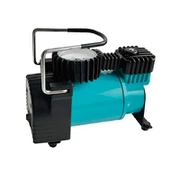
How a Metal Tire Pump Works
Feb 18, 2025
Cars have become an indispensable means of transportation in people's lives. The air pressure of car tires has a vital impact on the driving safety, comfort and service life of the vehicle. Metal tire pumps, as a device specifically used to inflate car tires, are particularly important. This type of equipment usually uses an air pump system driven by an electric motor to achieve the tire inflation function. Its design concept is based on high efficiency, convenience and the ability to meet the needs of car tire inflation.
Working principle of metal tire pump:
1. Motor drive
The power source of the car tire pump is often the car's own 12V battery, which is a standard power supply method carefully designed by the car's electrical system. When we need to use a metal tire pump, turning on its power supply is like starting a power journey inside the air pump. As the core power component of the entire inflation process, the electric motor starts to operate the moment it receives current. This operation is not a simple mechanical movement, but is supported by precise electromagnetic principles. When current passes through the coil inside the motor, a magnetic field is generated, which interacts with the permanent magnet inside the motor, thereby driving the motor's rotor to start rotating. And this rotor drives the piston or blade in the air pump to move through a mechanical connection. This mechanical connection is like a bridge for power transmission, accurately transmitting the motor's rotational power to the piston or blade, so that the entire air pump system starts working.
2. Pumping and compression
During the pumping stage, the valve inside the air pump opens, and this process is like opening a door to the outside world of air. The design of the air pump enables it to accurately capture the surrounding air and allow external air to enter the cylinder. The valve here has a unique structure and function, and it can open and close at the right time to ensure the smooth flow of air in and out.
As the motor continues to run, the piston or blade begins their compression mission. The piston moves back and forth in the cylinder like a hardworking piston worker. When the piston moves downward, the space in the cylinder increases, the air pressure decreases, and the outside air rushes into the cylinder as if being attracted; when the piston moves upward, the space in the cylinder gradually decreases, the air is squeezed, and the pressure begins to rise. If it is a blade-type air pump, the blades continuously compress the air toward the center of the cylinder during the rotation process. This compression process is an energy conversion process, and the electrical energy of the electric motor is converted into the potential energy of the air through the movement of the piston or blade.
During this process, we can feel the vitality and tension inside the air pump. The air molecules are squeezed and collided in the air cylinder, just like a crowded crowd. They were originally free, but now they are confined to a smaller and smaller space, and the pressure gradually increases. The temperature in the air cylinder will also rise slightly due to the compression of the air. This is because the friction and collision between air molecules intensify, and the energy is converted into heat energy. Although this temperature increase is not obvious, it is also a small detail in the working process of the air pump. It reflects the conversion of energy between different forms.
3. Inflation
When the air pressure in the air cylinder reaches a certain value, the valve is closed, which is a very critical moment. This pressure value is carefully designed and tested. It must ensure that enough air can be filled into the tire, but it cannot be too high to avoid safety hazards. The closed valve is like a loyal guard, preventing the air in the air cylinder from flowing back and ensuring the one-way flow of compressed air.
The compressed air is injected into the tire through the inflation hose and the air nozzle. The inflation hose is a flexible and sealed pipe that can tightly connect the air pump to the tire to ensure that the air can be transmitted smoothly. The air nozzle is a component that perfectly matches the tire valve. It is designed to form a good seal when inserted into the tire valve to prevent air leakage.
During the inflation process, we can see that the tire gradually becomes fuller. The originally flat tire slowly regains its round shape as air is injected. This process is like injecting vitality into a tired person, and the tire gradually becomes full of vitality from a weak state. Moreover, this process will be repeated until the tire reaches the required air pressure. Each repetition is a supplement to the tire pressure, like a gradual improvement process to ensure that the tire can reach the best inflation state.
4. Automatic power off
Modern metal tire pumps are usually equipped with an automatic power off function, which is an important manifestation of modern technology in the field of automotive accessories. With the continuous development of automotive technology, the safety and intelligence requirements for automotive tire inflation equipment are also getting higher and higher.
When the air pressure in the tire reaches the preset value, the air pump will automatically stop working to prevent overfilling. This preset value can be set according to different tire types and vehicle requirements. There is an air pressure sensor inside the air pump, which is like a sensitive feeler, always monitoring the air pressure in the tire. When the air pressure sensor detects that the air pressure in the tire reaches the preset value, it will send a signal to the air pump's control system. After receiving this signal, the control system will immediately cut off the power supply to the electric motor, thereby stopping the air pump from working.